View Case Study

Docly
About
Docly is a conceptual web service for booking medical appointments in the U.S., created as part of Major Studio I. The project was driven by a simple question: How might we create a unified, trustworthy booking experience that gives users control, clarity, and confidence. The concept prioritizes users’ understanding of where they are in the process, what information matters, and what happens next - without forcing them to jump between multiple platforms. A strong emphasis was placed on product architecture, flow, and iterative prototype testing to validate key UX decisions.
Scope
  • Brand Identity
  • Design audit
  • UX/UI design
  • Prototyping
  • Design System
Role
  • Product Designer
  • Brand Designer
Problem Statement
Booking a medical appointment in the U.S. is a fragmented and confusing experience. Information about doctors, availability, and insurance coverage is scattered across multiple platforms.
This lack of control and transparency turns an already stressful task into a tense and time-consuming process.
As a result, users often feel uncertain, disconnected, and frustrated before they even see a doctor.
HMW question
How might we create a unified, trustworthy booking experience that gives users control, clarity, and confidence — while keeping insurance, availability, and care seamlessly connected?
Competitive Audit
To better understand the landscape of online healthcare booking, I explored how existing market leaders approach the booking process.
Key areas
01. Booking flow
How competitors navigate users from search to confirmation.
02. Architecture
How competitors structure the information like doctor details, etc.
03. UX patterns
How competitors shape user experience through forms, etc.
04. Visual language
How competitors use content and density to create trust and clarity.
Zocdoc audit
Healthgrades audit
Vitals audit
Research questions
Based on insights from the competitive audit, three research questions were formed to guide user interviews and inform design decisions throughout the project.
Question 1
Where do users experience the most friction or uncertainty in the booking process?
Question 2
What makes a booking experience feel native and clear to users?
Question 3
What role does insurance play in shaping users’ booking decisions?
Users
A total of five in-depth interviews with participants aged 25 to 54 were conducted, including both regular and occasional patients. All participants had prior experience booking medical appointments in the U.S. — through Zocdoc, insurance provider websites, etc.
Insights
Insight 1
Insurance uncertainty breaks user confidence.
Insight 2
Users prioritize control and transparency over multi-step flows.
Insight 3
Clear communication and confirmation define trust.
Insight 4
Convenience outweighs all other factors.
Full user interviews
Affinity map
Ideation
01. System map
Based on insights from user interviews and the competitive audit, the system map was build from scratch to define the full web service ecosystem.
The goal of the system map was to understand how different flows, decisions, and dependencies interact within the product, and to identify where complexity, uncertainty, or friction could be reduced through clearer structure and continuity.
System map
02. wireframing
A mid-fidelity wireframes were created to translate the defined architecture into testable screens and interactions.
The wireframes focused on validating key flows, reducing cognitive load, and maintaining continuity across the booking process before moving into detailed UI design.
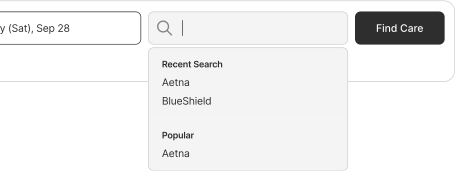
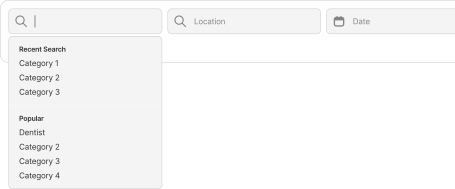
Homepage
Homepage filtering example 1
Homepage filtering example 2
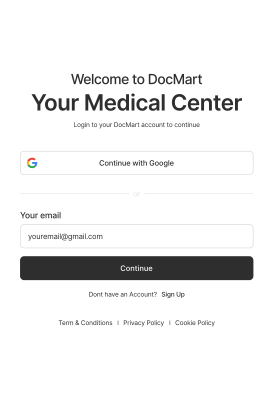
Log in form
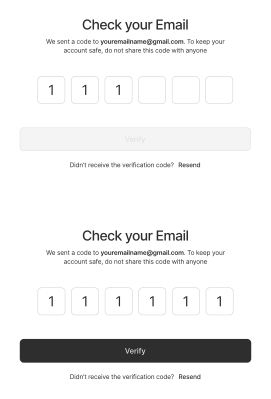
Verification form
Create an account
Browse page opt. 1
Browse page opt. 2
Book an appointment opt. 1
Book an appointment opt. 2
Appointment booking confirmation
user Test Findings
01. Browse Page Сards
A/B testing of doctor card layouts on the search page presented a specific challenge. This is an area where individual preferences play a major role, and during the initial round, users didn’t provide clear feedback.
However, additional scenario-based tasks revealed that displaying doctor cards in a single row along with a visible map significantly improved both the decision speed and confidence during selection.
02. Book an Appointment
A/B testing confirmed the hypothesis that a continuous, uninterrupted interaction flow leads to better process understanding and adds a sense of transparency.
Combining the booking and doctor profile pages also proved successful users noted the convenience of staying within one window, with access to both the map and quick navigation between layers.
Test approved browse page and card
Failed during A/B testing
Test approved book an appointment full flow
Brand Identity
brand message
Human Flow of Care
details
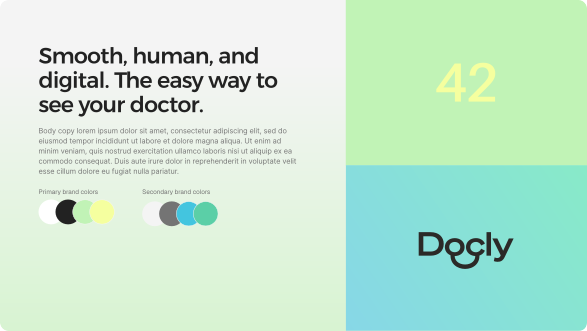
Smooth, human, and digital. The easy way to see your doctor. It is built to simplify the way your book an appointment. It thrives to make it routine.
It brings together empathy, trust, and technology into a smooth, human-centered experience that helps people book medical appointments without stress or confusion.
The brand reflects efficiency and digital clarity while also balancing the reliability of a medical service with the warmth of human interaction.
the final prototype
The final prototype brings together the defined architecture, user-tested flows, and brand direction into a cohesive web service experience.
back to